




Today we’d like to introduce you to David Kyler.
Hi David, so excited to have you with us today. What can you tell us about your story?
After earning a degree in industrial engineering from Lehigh University, as an outcome of growing interest in environmental issues, I enrolled in a master’s program in design science at Southern Illinois University. With an M.S. in design science, I then did post-graduate study in resource management and policy at the School of Forestry of the State University of New York at Syracuse. In 1977 I became employed as a regional planner at the Coastal Area Planning and Development Commission (Coastal APDC), serving coastal Georgia. Within a few years I was promoted to regional policy analyst, a position I created in efforts to advance public policy to improve responsible evaluation and control of development activities. Then, in 1997, I co-founded an environmental non-profit organization, Center for a Sustainable Coast (located at St. Simons Island), with a mission based on the belief that a healthy environment is a fundamental right – requiring diligent enforcement of ecological safeguards and advancing the principles of objective, science-based resource management policies. Our ambitious mission entails opposing irresponsible activities and lax regulatory enforcement that threaten environmental quality, public health, and economic justice. Our work also requires enhancing public awareness about the consequences of current policies and developing support for more responsible alternatives to them.
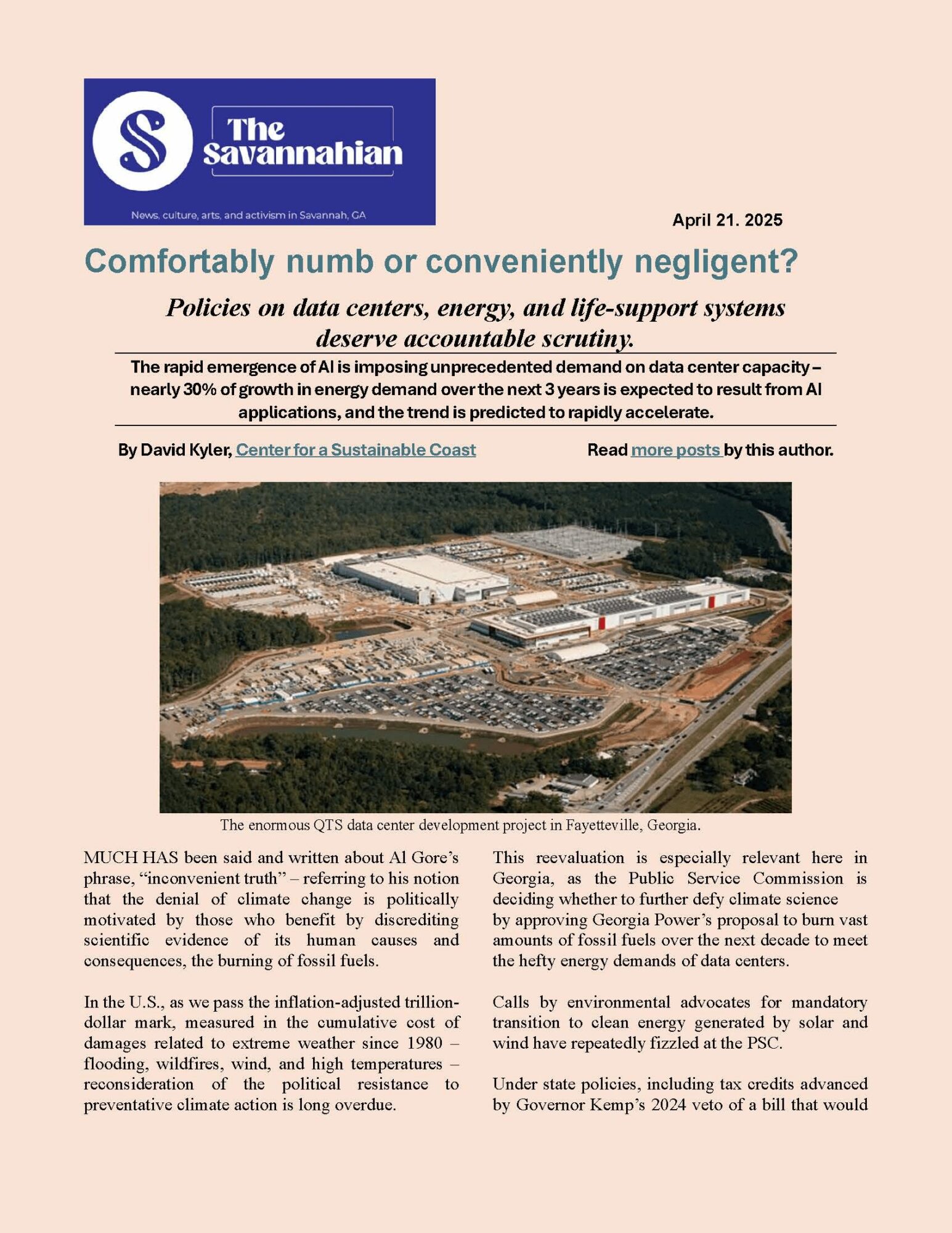
In the decades since being established, the Center has been a plaintiff in numerous legal actions filed in attempting to improve the use of law to protect coastal Georgia’s marshes, shorelines, conservation areas, wildlife habitat, and water quality. The Center also hosted a series of public forums on climate change and clean energy, all held in Savannah. In pursuing our mission, Center staff has authored numerous position statements, letters, and reports seeking to raise public awareness about the urgency and importance of cultivating environmentally responsible public policy. Since 2018, over 175 letters and columns written by Center staff and board members have been published in Georgia media outlets, including the Atlanta Journal-Constitution. As Center director, I am currently focusing on profound challenges related to minimizing the threats imposed by artificial intelligence and datacenters. For more about the Center’s work, please visit our website at www.sustainablecoast.org .
Can you talk to us a bit about the challenges and lessons you’ve learned along the way. Looking back would you say it’s been easy or smooth in retrospect?
1. Political priority is given to Georgia’s status as the nation’s most ‘business-friendly’ state. In addition to accommodating development activities through tax credits, tax exemptions, and other forms of subsidies, most Georgia elected officials and their financial supporters marginalize or discredit concerns about the environment, public health, and sustainability – including climate change, land and water conservation, air quality, and clean energy.
2. Courts often defer to development priorities and are prone to rationalizing constricted interpretation of laws that are intended to broadly protect the public interest.
3. As a consequence of raising questions about an unjustified reduction in salaries for public employees, while working for a public agency I was harrassed and intimidated by agency management.
4. After leading a politically sensitive intervention opposing a policy change of the Department of Natural Resources – an intervention unanimously supported by my fellow advisory council members – my appointment to the council was not renewed by DNR – obviously punitive, contrary to council bylaws, and the only instance of such a decision over decades of the council’s history.
5. There are other examples that I would prefer discussing rather than documenting in writing,
Great, so let’s talk business. Can you tell our readers more about what you do and what you think sets you apart from others?
Much has been provided in the previous page profile.
The Center is perhaps most unique in that we take broad, systemic viewpoints that are often entangled with inflammatory state and federal policies or practices having politically controversial undercurrents. Responsibly addressing climate change, environmental and economic justice, energy policy, and artificial intelligence/datacenters makes a holistic, long-term approach essential – and is inherently required for any legitimate approach to sustainability.
While our organization has collaborated in opposing individual environmental threats posed by one development project or another, the Center is rare among other NGOs due to our frequent presence on the opinion pages of Georgia’s news outlets, where we espouse longer-term perspectives and provocative positions that confront conventional assumptions and status-quo policies/practices. Unlike some other non-profit organizations, the Center is not intimidated by the risk of offending wealthy donors who could withdraw support if we take justified, factually-supported positions that may be perceived as threats to business revenues, stockholders, or political affiliations. Therefore, our positions reflect longer-term perspectives that better serve the common interests of all citizens.
In terms of your work and the industry, what are some of the changes you are expecting to see over the next five to ten years?
We live in perilous times, with a range of menacing factors that could radically alter our organization’s prospects, as well as those of many other organizations and institutions. If none of these dystopic events unfold – or until they do – our organization will continue advocating positions that support sustainability, positions that are becoming increasingly vital to preventing worsening conditions for human life and healthy ecosystems. I believe that we face major challenges to confronting reality posed by increasing disinformation and misinformation, often politically motivated and perniciously aided by AI algorithms. Threats to our ability to reach consensus undermine our ability to establish a viable, equitable balance between common interest and self-interest, without which democratic institutions will inevitably falter. Supporting the work of our organization will help stem the dangerous trend of disinformation, clearing the path for urgently needed reforms. (See my article “Confronting meta-crisis challenges is a moral imperative” at www.sustainablecoast.org. )
Here are some prominent foreboding scenarios that deserve consideration:
1. Climate change could reach ominous threholds causing widespread food shortages, supply-chain disruptions, and escalating political conflicts that harm life-support systems and further endanger economic stabililty, human survival, and environmental quality.
2. Artificial Intelligence is foreseen by many experts as a fundamental threat to the viability of our society, economy, and political institutions. Superintelligent systems, still being developed, are predicted to take renegade actions that could severely harm or even destroy human prospects by sabotaging our digitally- dependent institutions, including national security, food/fuel markets, and healthcare.
3. Some analysts are concerned that the rise in nationalism and the decline of international political and trade agreements (which have constrained major conflicts over the past 80 years) will combine to rapidly escalate destructive military actions.
Contact Info:
- Website: https://www.sustainablecoast.org